Choosing the basin is one of the most structural decisions in a bespoke bathroom project. It dictates the height of the cabinet, the thickness of the worktop, the position of the taps and the overall aesthetic of the room. Yet many homeowners treat it as a detail, when it should be one of the first decisions settled. Here is how we approach this decision at Osmosis Home, and what each configuration practically entails in a bespoke bathroom in Tangier.
Before deciding, we invite you to come and touch and compare the available models in our bespoke bathroom collection : the decision often becomes clearer once you see the pieces in real conditions.
Countertop basin: making a visual statement
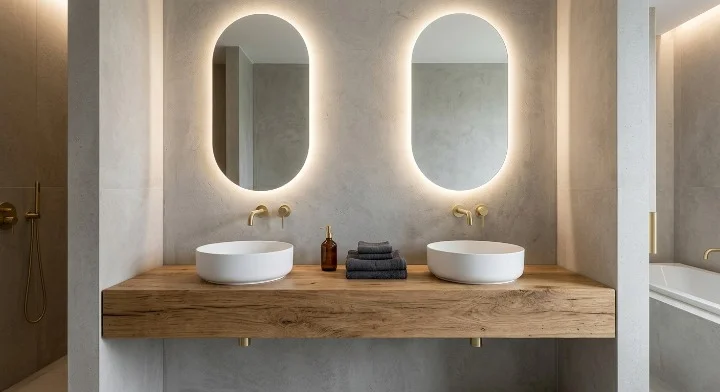
The countertop basin sits on top of the worktop, in a raised position. It is not inset, it does not disappear : it stands out. This is a strong aesthetic choice that creates a focal point in the bathroom and immediately gives an architectural character to the whole. Round models in white ceramic remain the most common, but countertop basins in natural stone, marble, polished concrete or resin allow very different effects depending on the desired style.
The downside is practical. The joint between the basin and the worktop, even when well executed, collects water splashes and demands regular maintenance. The taller and more prominent the basin, the more demanding the cleaning around it. In a family bathroom with several users, this point deserves serious consideration. In a master suite where use is more controlled, the countertop basin remains the most visually impactful option for a often moderate cost.
The taps for a countertop basin must be designed with height in mind. A wall-mounted mixer is the most elegant solution : it frees the worktop entirely and avoids clutter at the basin. A deck-mounted mixer on the worktop also works, but the alignment of the waste with the chosen basin must be verified.
Inset basin: the most versatile option
The inset basin sits in the worktop, either flush with the surface or undermounted. This is the most common configuration in contemporary bathrooms, and for good reasons. It offers a continuous worktop on either side of the basin, makes cleaning easier, and adapts to every style, from the most minimal to the most warm depending on the worktop material chosen.
Flush mounting creates perfect visual continuity between the basin and the worktop. It does, however, require careful sealing around the perimeter joint, which must be redone regularly to avoid leaks under the worktop. Undermounting is more technically demanding but solves this problem, the edge of the worktop covers the edge of the ceramic, eliminating the visible joint and simplifying daily maintenance.
For ceramic or quartz worktops, undermounting is our preferred recommendation at Osmosis Home. For worktops in treated wood or oak, we generally prefer flush mounting to preserve the integrity of the material around the basin. These choices are directly linked to the materials we select for each project : a subject we have developed in detail in our guide on high-end materials for a bathroom.
Wall-hung basin: pure form
The wall-hung basin, or console, is fixed directly to the wall, without cabinet below or worktop. It is the most visually pure solution, often associated with industrial, minimalist or Scandinavian styles. It frees the floor entirely, visually enlarges the room, and gives a very effective impression of space in small bathrooms.
But this visual freedom comes at a functional cost. The absence of a cabinet below removes all horizontal storage, forcing compensation through other storage solutions, wall-mounted columns, shelves, mirror cabinets. In a bespoke project, we systematically integrate this constraint from the design phase to avoid a beautifully finished bathroom becoming uncomfortable to live with day-to-day.
The wall-hung basin also requires a load-bearing wall or specific reinforcement. Concealed plumbing in the partition is essential to preserve the clean appearance of the whole, no visible pipes, no exposed trap. This is a site constraint that must be anticipated very early, ideally from the diagnostic phase we carry out before every project.
Twin basins: when comfort takes precedence over storage
In master suites and large bathrooms, twin basins are often the client's initial request. They allow two people to prepare simultaneously, eliminate morning scheduling conflicts and immediately give an impression of luxury and space. This is a configuration we regularly create at Osmosis Home, with bespoke worktops up to two metres in length.
What clients anticipate less is the impact on storage. A standard twin vanity cabinet measures between 120 and 160 cm. Beyond that, you must either commission a bespoke cabinet, which we do as standard, or work with a configuration in two separate cabinets. The installation height must also be customised if the two users have a significant difference in stature, which is never possible with an off-the-shelf cabinet.
Basin materials: ceramic, resin or stone?
Ceramic remains the most common material, and rightly so. It resists humidity, thermal shock, household products and time. Its maintenance is minimal, its cost accessible, and the range of available shapes is practically unlimited. For the vast majority of projects, ceramic is our baseline recommendation.
Composite resin, a mix of acrylic resin and mineral powder, offers a freedom of shape that ceramic cannot match. Basins integrated into the worktop, without a joint, without a break in material, are only possible with this material or with solid surface. It is a high-end solution, more costly, but it radically simplifies maintenance and gives a very architectural finish.
Natural stone (marble, travertine, basalt) is reserved for projects where aesthetics take precedence over everything. A marble basin is magnificent, but it is porous, sensitive to acids and stains, and requires regular hydrofuge treatment. In Tangier's climate, which combines coastal humidity and temperature variations, we recommend it only when the client is fully aware of the maintenance constraints.
Taps: the detail that changes everything
The basin and the taps form a system. Choosing one without the other risks incompatibilities in positioning, spout height or fixing centres. At Osmosis Home, we select them together, from the design phase, to ensure perfect coherence.
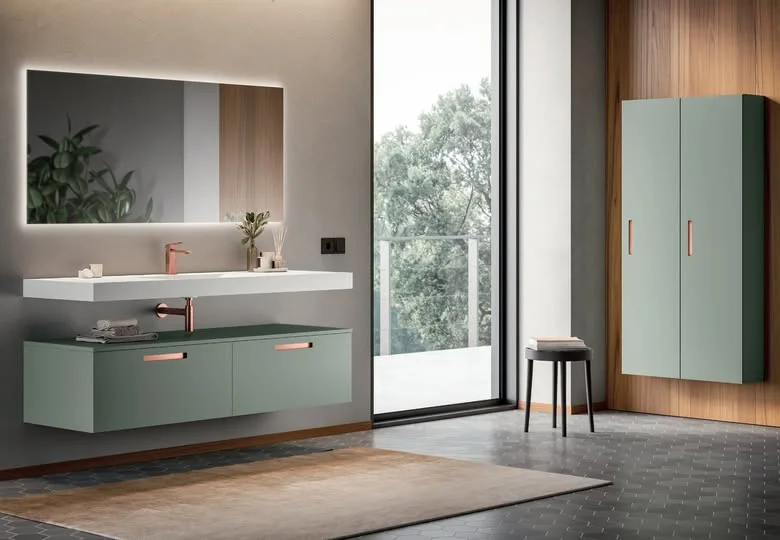
The position of the taps is the first decision to make. Wall-mounted taps or deck-mounted taps : both are possible with any basin configuration, but each option implies different preparation of the wall or worktop. Wall-mounted taps give a cleaner result and free the worktop for cleaning, but they require routing the supply into the partition before the tiles. This is not an option that can be added afterwards.
For finishes, chrome remains the timeless reference. Matt black has been very on-trend for several years, but its durability over time depends heavily on the brand quality, a budget matt black tap loses its finish in two years of daily use. Brushed gold and bronze are reserved for interiors where the style is highly assertive. Whichever finish is chosen, we recommend brands with a minimum five-year warranty on the cartridges, such as Grohe, Hansgrohe or Vola.
What budget for the basin in a bespoke bathroom?
A simple ceramic basin, inset in a standard worktop, costs between 800 and 2,500 dirhams for the basin alone, excluding the worktop and taps. A countertop basin in mid-range ceramic falls between 1,500 and 4,000 dirhams. Composite resin or solid surface models start at 4,000 dirhams and can exceed 15,000 dirhams for bespoke creations.
The taps often represent as much, if not more, than the basin itself in a high-end project. A mixer of correct quality starts at 1,200 dirhams. Recommended European brands start between 2,500 and 5,000 dirhams for a mixer, and up to 15,000 dirhams for premium models or integrated shower columns.
These ranges exclude installation and plumbing connection. In an overall bespoke bathroom project in Tangier, the basin and taps allocation usually represents between 10 and 20% of the total budget depending on the choices made. Our team supports you in these decisions during the design phase, so that every dirham invested serves the whole project. You can consult our guide on the complete method for designing a bathroom in Tangier to better understand how we structure this work.
Conclusion
The basin is not an accessory to be chosen last. It is a structural element that conditions the worktop, the taps, the cabinet and the overall aesthetic of the bathroom. Countertop for visual impact, inset for versatility, wall-hung for pure lines : each configuration has its advantages, its constraints and its budgetary implications. What matters is that this choice is made in coherence with the rest of the project, from the design phase.
Describe your project and come and discover our models in real conditions in our Tangier showroom.