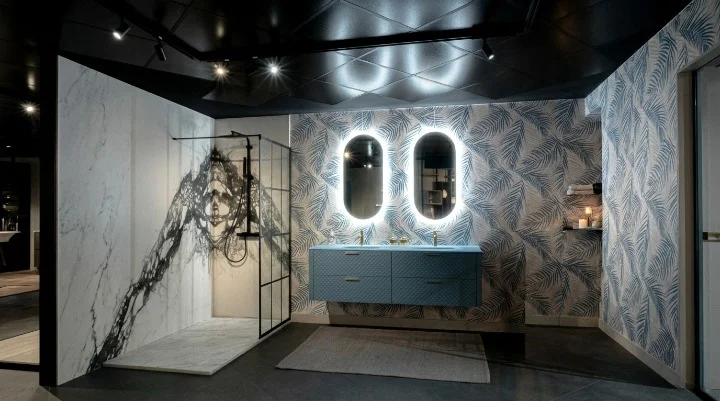
A bespoke bathroom is not a collection of furniture pieces purchased separately. It is an integrated architectural project that must withstand fifteen to twenty years of humidity, summer heat and the salt-laden air of Tangier. Here is how we work at Osmosis Home: the key decisions to make before the project begins, the materials that genuinely last in our climate, and realistic price ranges for 2026.
You can also see and feel all these materials and finishes in our bespoke bathroom universe before making your decision.
Why a bathroom isn't just an assembly of furniture
The most common mistake in Tangier is to design a bathroom like a shopping list: a vanity unit bought from one store, a mirror found elsewhere, tiles chosen at a third showroom, a shower ordered from a fourth supplier, and a plumber who assembles it all. The result is almost always disappointing, colour mismatches between materials, inconsistent heights, dubious sealing at junctions, uneven finishes.
A bathroom is a closed system in which every element interacts with the others. The height of the vanity unit depends on the chosen tap. The thickness of the worktop depends on the depth of the basin. The shower position dictates the floor gradient. The type of tile influences the lighting required. Thinking through these elements together, from the design phase, radically changes the quality of the final result.
Tangier's climate adds a constraint that many homeowners underestimate. Coastal humidity, the temperature swing between mild winters and hot summers, and the presence of salt-laden air attack fragile materials. A bathroom designed with unsuitable products can begin to deteriorate as early as the second year, joints turning black, hinges rusting, panels warping.
Full refurbishment or partial renovation?
The first question is not aesthetic but technical. If the plumbing is more than twenty years old, if the waterproofing shows signs of weakness, or if the floor has cracks, a partial renovation is a false economy. You will repaint and re-tile over foundations that will give way in five years' time. A full refurbishment costs more upfront but guarantees fifteen to twenty years of peace of mind.
Conversely, if the structure is sound and you simply want to modernise the aesthetic, a well-thought-out partial renovation can deliver excellent results. The key is an honest diagnosis carried out before any quotation.
Walk-in shower, wet-room shower or enclosure?
The term "Italian shower" is now used to describe three different things. A true walk-in shower is recessed into the floor, with no visible tray and a slope built into the screed, the most elegant solution but also the most demanding in terms of waterproofing. A wet-room shower with an extra-flat tray offers 90% of the visual effect for 60% of the cost and complexity. The traditional shower enclosure remains relevant for small spaces or rentals.
The choice depends on available space, household composition and budget. A family with young children may prefer a safer enclosure. A couple without children would do well to invest in a true walk-in shower.
Wall-hung or floor-standing vanity unit?
The wall-hung unit has become the norm in modern bathrooms, and for good reason. It frees up the floor visually, simplifies cleaning, and allows for indirect lighting beneath. But it requires a sound load-bearing wall or a through-bolt fixing, and adds an extra cost for reinforcement.
The floor-standing unit remains relevant in larger bathrooms where the contrast with a suspended shower would create imbalance, or in partial renovations where the existing wall is left untouched.
Inset, countertop or integrated basin?
The inset basin sits within the worktop, flush or under-mounted. It is easy to maintain but requires a sufficiently thick worktop. The countertop basin, sitting on the worktop, is more visual but catches splashes and complicates cleaning around its edge. The integrated basin, carved from the worktop itself in solid surface or marble, is the highest-end option, no joints, clean aesthetics, minimal maintenance. It is also the most expensive.
Floor and wall tiles or mineral finishes?
Porcelain tiles remain the dominant choice in Tangier for their value-for-money and resistance to humidity. But alternatives are gaining ground. Polished concrete offers a continuous mineral effect without joints, but remains sensitive to infiltration if poorly applied. Traditional tadelakt is sumptuous and 100% Moroccan, but expensive and demanding to maintain. Resin coating is very modern, guaranteed waterproof, but susceptible to scratches.
For most projects, we recommend porcelain tiles with a stone or marble finish for the floor, and high-resistance specialised paint or tadelakt for walls outside splash zones. This mix combines durability and aesthetics without the pitfalls of overly fragile materials.
Materials that withstand Tangier's climate
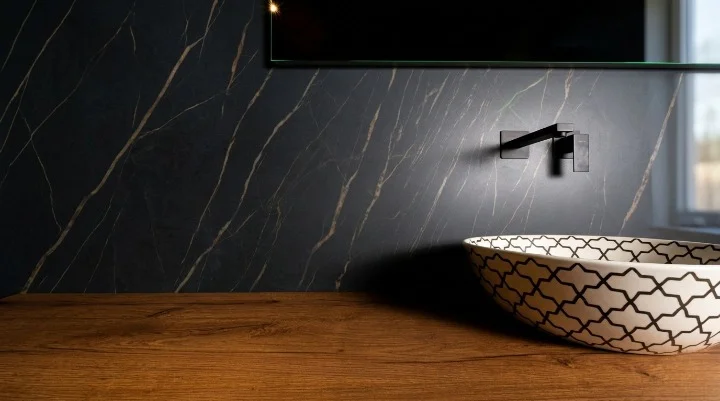
Tangier is not Marrakech or Casablanca. The air is more humid, more saline, and the temperature swings sharper. Choosing materials designed for a temperate continental climate exposes you to rapid deterioration. We have devoted an entire guide to the high-end materials suited to a bathroom, but here is the essence of our proven selection for the Tangerine climate.
Through-body porcelain is our standard for floors. It withstands prolonged humidity, resists shocks and keeps its colour for decades. Natural marble, magnificent but porous, requires annual hydrophobic treatment and remains vulnerable to acid stains, soap, toothpaste, lemon juice. For floors, we recommend porcelain at least 9 mm thick, with a minimum R10 anti-slip rating.
For vanity tops, ceramic remains the most durable and lowest-maintenance choice. Marble composite, a blend of marble powder and resin, offers the look of marble without its fragility, at an intermediate price. Solid surface, of the Corian or Krion type, allows free shapes, seamless integration and repair by sanding in case of scratches : it is our material of choice for high-end projects.
Tap quality is one of the points where the difference shows most quickly. A budget tap will tarnish in two years, lose its chrome and eventually leak at the cartridge. We recommend recognised European brands such as Grohe, Hansgrohe, Vola or Dornbracht depending on budget, with a minimum five-year warranty on cartridges.
For furniture, a standard MDF bathroom unit will warp in less than five years in a Tangerine bathroom. The only acceptable panels are green-tinted moisture-resistant MDF, moisture-resistant melamine particle board, or marine plywood. Hinges and runners must be stainless steel or chrome-plated brass, with a minimum ten-year warranty, Blum, Hettich, Hafele.
How much does a bespoke bathroom in Tangier cost in 2026?
A common question, with an answer that depends on scope. Here are the ranges we observe on the Tangier market in 2026, for complete projects including supply and installation. A simple renovation of 5 to 7 m² lies between 35,000 and 60,000 dirhams. This budget covers a refurbishment with standard tiling, a bespoke vanity unit, a mirror, a shower with extra-flat tray, mid-range tap, and plumbing rework without changing the layout.
An intermediate bathroom of 6 to 10 m² ranges from 60,000 to 110,000 dirhams. This level adds a true recessed walk-in shower, multi-source architectural lighting, high-end materials (porcelain tiles with a stone or marble finish, or marble composite) and a possible change of layout.
A high-end bathroom of 8 m² and above starts at 110,000 dirhams, with no real ceiling depending on choices. This level allows for full solid surface, tadelakt walls, premium tap, a unit in fine wood or lacquer, integrated LED mirrors, and the installation of architectural elements such as a stone bench inside the shower.
An invisible but decisive cost item: plumbing, waterproofing and ventilation. Across a total budget, these hidden items often represent thirty to forty percent of the final cost. This is precisely where overly low quotations make dangerous savings, paid for ten years later. A quote for a complete refurbishment under 25,000 dirhams is a warning sign : either the plumbing will be left as is despite its age, the waterproofing will be done on the cheap, or the materials are far below what the quote implies.
Our method at Osmosis Home
Our designer first visits you at home to take precise measurements, observe the existing plumbing, identify structural constraints and listen to your project. This diagnostic visit lasts forty-five minutes to an hour, free and without obligation. You then come to our showroom on Avenue Abdrahman El Youssoufi for the 3D design phase and material selection. We project your future bathroom in three dimensions, you handle the materials physically, you test the tap, you compare basins, and we refine together until full visual approval.
We then issue a quotation that itemises every cost : demolition, plumbing, waterproofing, tiling, furniture, tap, lighting, paint, ventilation, finishes. No vague "finishings package" or "to be assessed on site" line items. You know exactly what you are paying for. Once the quote is signed, we coordinate every trade: plumber, tiler, electrician, joiner. You have a single point of contact, who keeps you informed each week of progress with photos.
Before handing over the keys, we carry out a documented waterproofing test on the shower, basin and drains. We check the joints, the proper functioning of the ventilation, the secure fixing of suspended elements, and the calibration of the tap. You can browse our recent projects to see the final rendering of several delivered bathrooms. And we guarantee the entire installation in writing, should any issue arise in the years that follow, you call us and we intervene within 72 working hours. No service outsourced abroad, no spare parts taking three months to arrive.
The MRE case: managing your renovation from abroad
A significant share of our projects is commissioned by Moroccans living in France, Spain, Belgium or the Netherlands. Refurbishing a bathroom in your Tangier flat without being on site every week is entirely feasible, provided a clear management method.
In practice, we offer MRE clients video consultations during the design phase, weekly photographic updates from the building site, electronic signature of quotations and payment by international transfer. Many of our clients designate a relative in Tangier for the most sensitive on-site approvals, for example, confirming the exact shade of the tile before installation. We integrate them naturally into the project communication.
The total time between the first visit and final delivery of a bespoke bathroom is between eight and fourteen weeks, depending on the complexity of the project. For MRE clients, we often synchronise delivery with a period of presence in Tangier (summer holidays, religious festivals) so you can verify the result on site.
Conclusion
A bespoke bathroom is not a juxtaposition of products: it is a coherent architectural project where every material, every dimension and every technical detail respond to one another. The Tangerine climate adds a further requirement that immediately rules out fragile materials and bargain-basement workmanship. Choosing a designer who masters both the aesthetic dimension and the local technical constraints makes the difference between a bathroom that lasts fifteen years and one that needs redoing in five.
Describe your project and benefit from the expert advice of our bespoke bathroom specialists in Tangier.