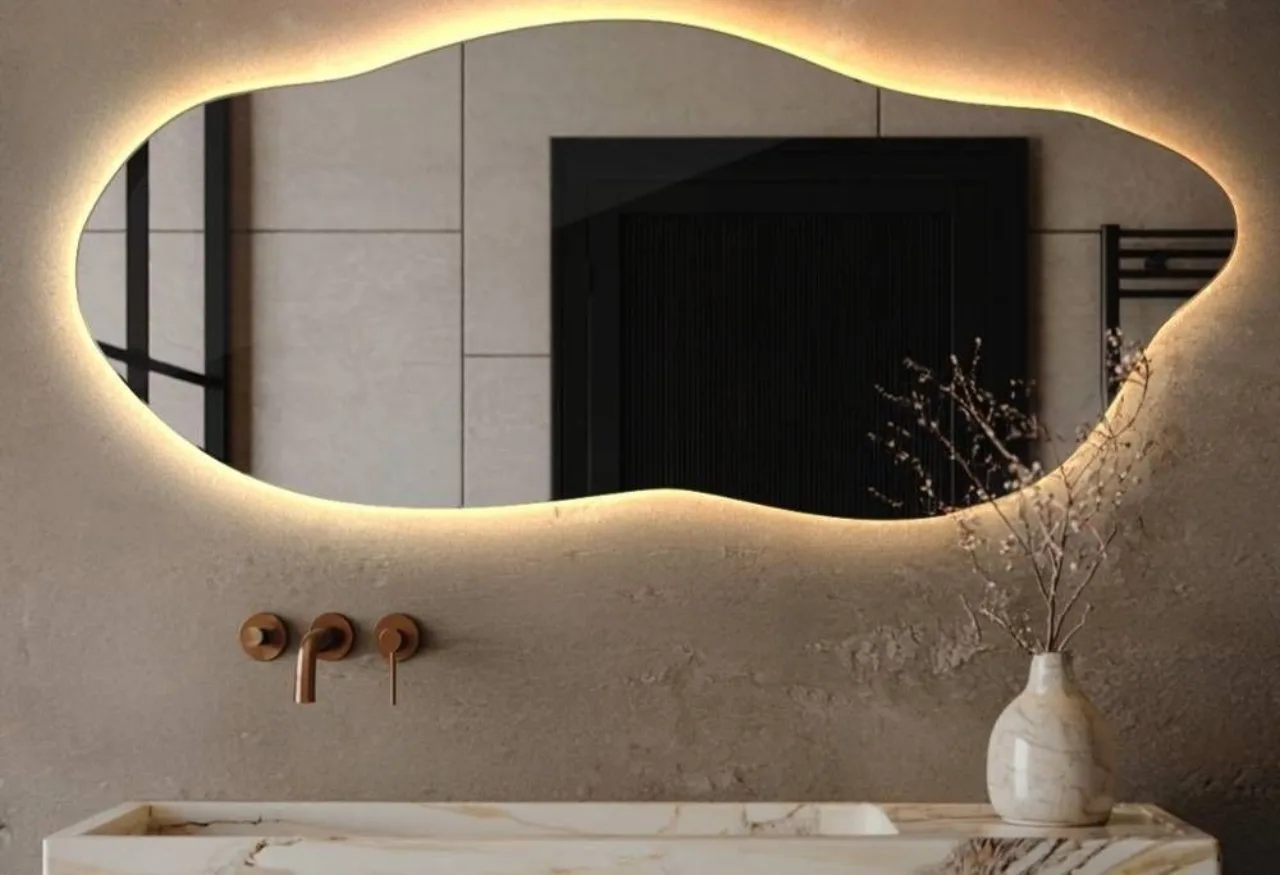
The mirror is often the last element considered when designing a bathroom, yet it is one of its most defining focal points. It captures light, gives visual structure to the space, and speaks precisely to the care invested in every detail. For a fully considered, custom-designed bathroom, the choice of mirror deserves as much attention as the wall cladding or the vanity top. In Morocco, the market today offers an exceptionally wide range, from entry-level options to architectural statements, and it is precisely this abundance that makes the decision challenging.
A structuring element, not an accessory
It is tempting to treat the mirror as a functional addition, a simple reflective tool placed at the end of the project. This approach produces bathrooms where the whole lacks cohesion, where the mirror appears to have been placed there by default rather than chosen with intention. In a room that relies on the quality of its materials and the accuracy of its proportions, the mirror contributes to the overall composition. Its shape, dimensions, and position in the space are far from incidental: they define the room's visual axis and directly influence the perception of both natural and artificial light.
Format and proportion: the rule of ratios
The first criterion to consider is the relationship between the width of the mirror and that of the vanity unit or surface above which it is hung. A mirror that is too narrow above a wide vanity top creates an immediate imbalance. Conversely, a mirror that extends well beyond its support can appear imposing and disrupt the room's verticality. The general principle is to align the mirror with the width of the vanity unit, allowing a few centimetres on either side to create a slight visual breathing room. In double bathrooms, two separate mirrors, one per basin, often provide a more balanced reading than a single large format. To refine this choice in relation to your bathroom vanity unit in Morocco, it is useful to think of the mirror and the unit as a unified whole from the very start of the design process.
Plain mirror or illuminated mirror: which to choose?
The backlit mirror, or LED mirror, has become widely prevalent in Morocco over recent years. Its appeal is genuine: it diffuses even, shadow-free light across the face, ideal for daily grooming. High-end models offer an adjustable colour temperature, ranging from warm white to neutral white, which noticeably shifts the atmosphere of the room at different times of day. A plain mirror, by contrast, places full responsibility for lighting on the wall sconces or recessed spotlights that frame it. Both approaches are valid, provided the ambient lighting is designed accordingly. In a bathroom where lateral wall sconces are already planned, a mirror without integrated lighting often sits with greater architectural discretion.
Shape: between classic and contemporary
The rectangular mirror with clean edges remains the reference in contemporary and minimalist interiors. It aligns naturally with the horizontal and vertical lines of the tiling, the vanity unit, and the grout joints, creating a coherent graphic reading. A round or oval mirror introduces an organic counterpoint in geometrically driven spaces : a single one is enough to soften a bathroom entirely structured by right angles. Arched mirrors, finally, are gaining in popularity for their ability to evoke a certain Mediterranean softness without veering into excessive ornamentation. The choice of shape must always respond to the stylistic logic already established in the room, rather than contradict it.
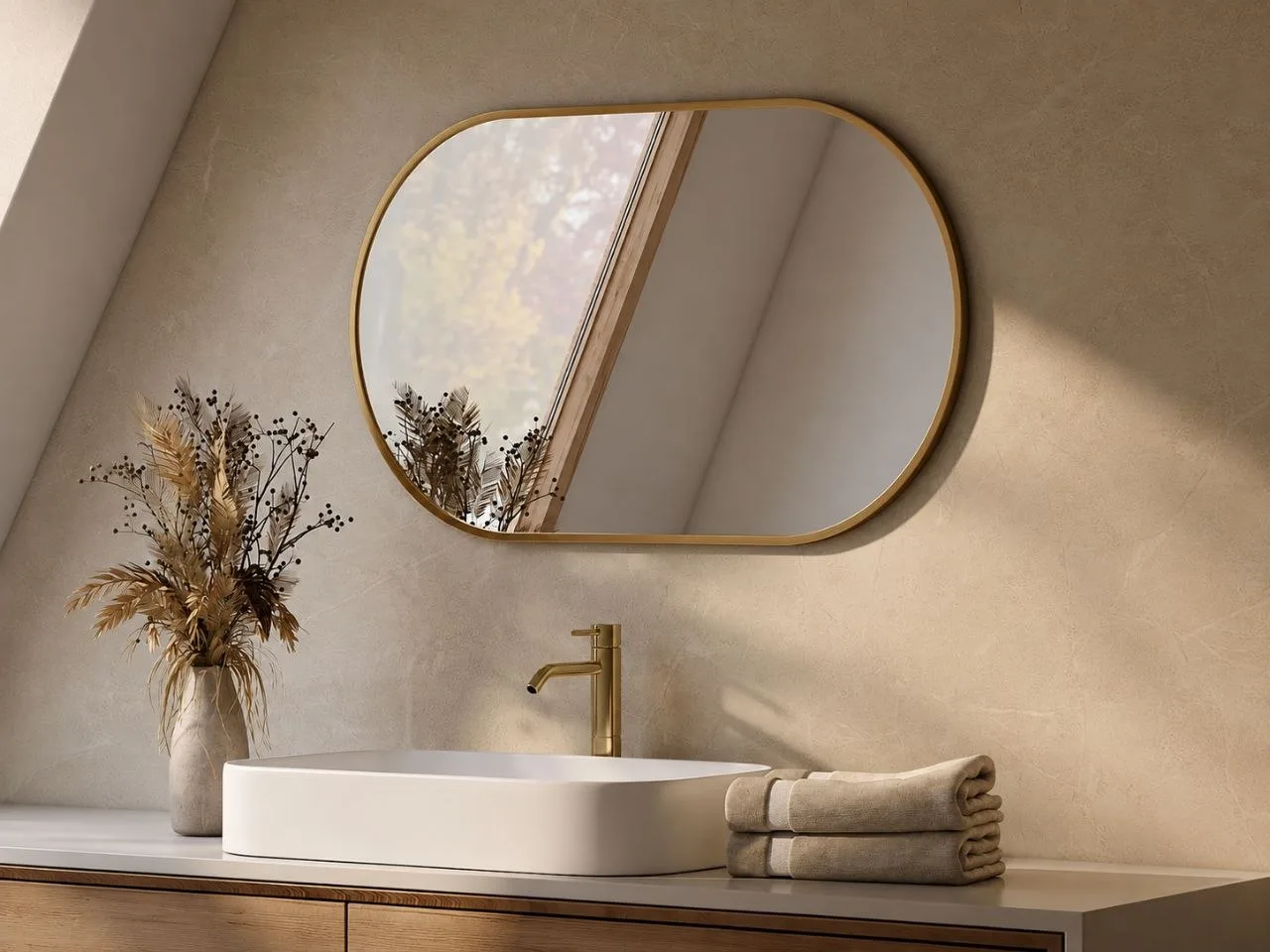
In a bathroom defined by understated materials, a backlit mirror with a brushed brass frame serves as both a luminous focal point and a structuring visual anchor.
Frame and finish: material and context
A frameless mirror, bevelled or flush-edged, suits interiors that favour the purity of surfaces. Suspended on invisible fixings, it recedes in favour of its own reflection. When a frame is present, it must engage in dialogue with the other metallic finishes in the room: taps, handles, towel rails. A brushed brass frame in a bathroom where the mixer taps are matte black creates tension rather than harmony. This consistency across metals is one of those details rarely noticed consciously, yet whose absence is felt immediately. Wood is also a possibility, provided the species or finish has been treated to withstand humidity, untreated wood in a bathroom will inevitably deteriorate.
Basin and mirror: designing both together
The mirror and the basin form a visual pair whose coherence determines the success of the room. A custom-designed bathroom basin with architectural contours naturally calls for a mirror with sharp, clean lines, whether framed or edgeless. A freestanding basin with a rounded form, on the other hand, may be accompanied by a mirror with a softer outline. Approaching these two elements independently is akin to assembling an outfit without coordinating the pieces. This coherence of design, which seems self-evident, is nonetheless rarely applied in projects where each element is ordered separately and at different stages of the build.
Mounting height: a frequently overlooked detail
The height at which a mirror is fixed determines its everyday comfort in use. A mirror positioned too high or too low quickly becomes impractical. The common principle is to place the centre of the mirror at the eye level of a standing adult, between 155 and 170 cm from the floor depending on stature. In a shared bathroom, it is sometimes preferable to adjust slightly downward to suit all users. The distance between the lower edge of the mirror and the vanity top must also be carefully managed: too great, and it creates a void that stretches the composition; too small, and it produces a sense of compression. Between fifteen and twenty centimetres generally represents a balanced interval, to be adjusted according to the mirror's overall height.
What you see in a showroom
It is difficult to assess the quality of a mirror from a product sheet or an online photograph. The thickness of the glass, the sharpness of the reflection, the quality of the backlighting, and the solidity of the fixing systems only reveal themselves in the physical presence of the object. Our showroom in Tangier, on Avenue Abderrahman El Youssoufi, allows you to observe materials as they truly are, under lighting conditions close to real-world use. It is often in this direct encounter that decisions become clear, and what seemed obvious on a screen proves unsuitable, or the reverse occurs. Our past projects illustrate how these detailed choices, far from being trivial, ultimately define the character of a space.
Conclusion
Choosing a bathroom mirror in Morocco means choosing an element that will be seen several times a day, under varying light conditions, and that actively contributes to the visual balance of the room. Its shape, dimensions, finish, and position are not matters of chance, but of coherent design thinking. A successful bathroom project treats the mirror not as a last-minute accessory, but as a fully considered piece, designed in relation to the vanity unit, the basin, the taps, and the lighting. If you wish to approach your project with this level of intention, describe your project and we will guide you from the very first decisions.