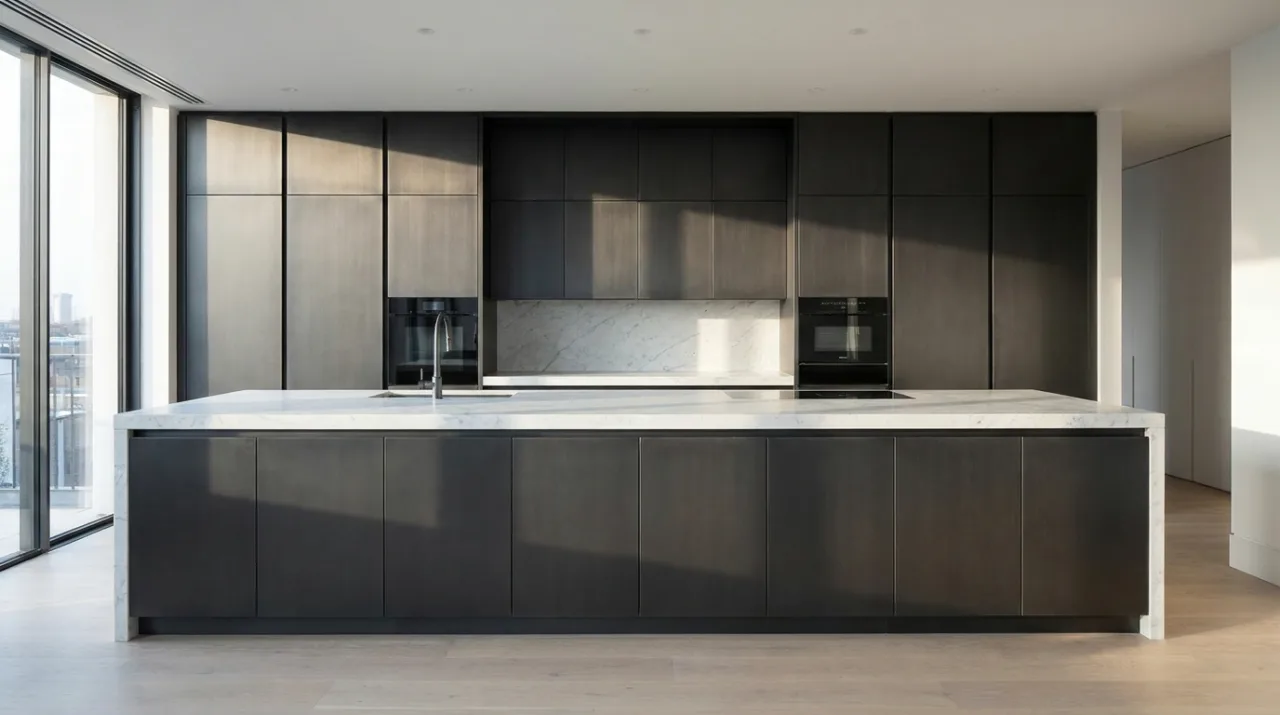
Stainless steel has established itself in recent years as one of the most sought-after materials for designing a custom fitted kitchen in Morocco. This is no passing trend: it is the logical response to a set of demands relating to durability, aesthetics and adaptation to the local climate. Understanding why this material appeals so strongly to discerning clients requires a careful examination of its real properties, its limitations, its pricing and its maintenance requirements.
Why stainless steel is particularly well suited to the Moroccan context
Morocco combines significant temperature variations between summer and winter, sometimes pronounced coastal humidity in Tangier, and intense sun exposure across most of the country. Stainless steel addresses each of these factors: it does not expand significantly under heat, does not warp under the effects of humidity, and naturally resists corrosion without additional chemical treatment. Where solid wood can shift and certain engineered panels lose their structural integrity over time, stainless steel maintains its geometry and flatness: qualities that are essential for kitchen doors whose hinges and runners must operate with precision for decades.
An architectural aesthetic that other materials struggle to replicate
Stainless steel offers a range of finishes that belongs more to the architectural register than to conventional domestic furniture. Anodised surfaces, industrial lacquers and brushed effects lend façades a visual depth that lacquered MDF, even of high quality, cannot match over the long term. Muted tones, anthracite greys, deep blacks and optical whites hold their character without yellowing or loss of saturation. This chromatic longevity is particularly valuable in a kitchen where artificial and natural light constantly shifts, either enhancing or exposing the quality of surfaces. It also explains why stainless steel has become the preferred choice in projects where the kitchen forms a central element of an interior's architectural composition.
Stainless steel or MDF: what the comparison actually reveals
This question arises in almost every project. If you wish to explore this point in depth, the detailed comparison between MDF and stainless steel kitchens in Morocco provides concrete answers based on your budget and intended use. To summarise the essentials: lacquered MDF offers an excellent surface at a lower cost, but its vulnerability to moisture at the base of cabinets and to edge impacts is a genuine limitation under intensive daily use. Stainless steel withstands the same constraints without any visible damage. At an equivalent finish level, stainless steel costs more, but the difference is offset once the lifespan of the installation is considered over fifteen to twenty years.
Pricing for a stainless steel kitchen in Morocco: what you need to know
Prices on the Moroccan market vary considerably depending on the supply source, the quality of the profiles and the complexity of the configuration. An entry-level stainless steel kitchen can start at around 15,000 to 20,000 dirhams for a small space with limited storage. A mid-range project, with quality façades and a suitable worktop, generally falls between 35,000 and 60,000 dirhams. At the premium level, where profiles come from certified European manufacturers, hardware features hydraulic damping, and the worktop is in engineered stone or natural stone, budgets frequently exceed 80,000 dirhams for a standard-sized kitchen. For a precise estimate based on your surface area and finish choices, the dedicated page on fitted kitchen pricing in Morocco details cost breakdowns and the logic behind quotations.
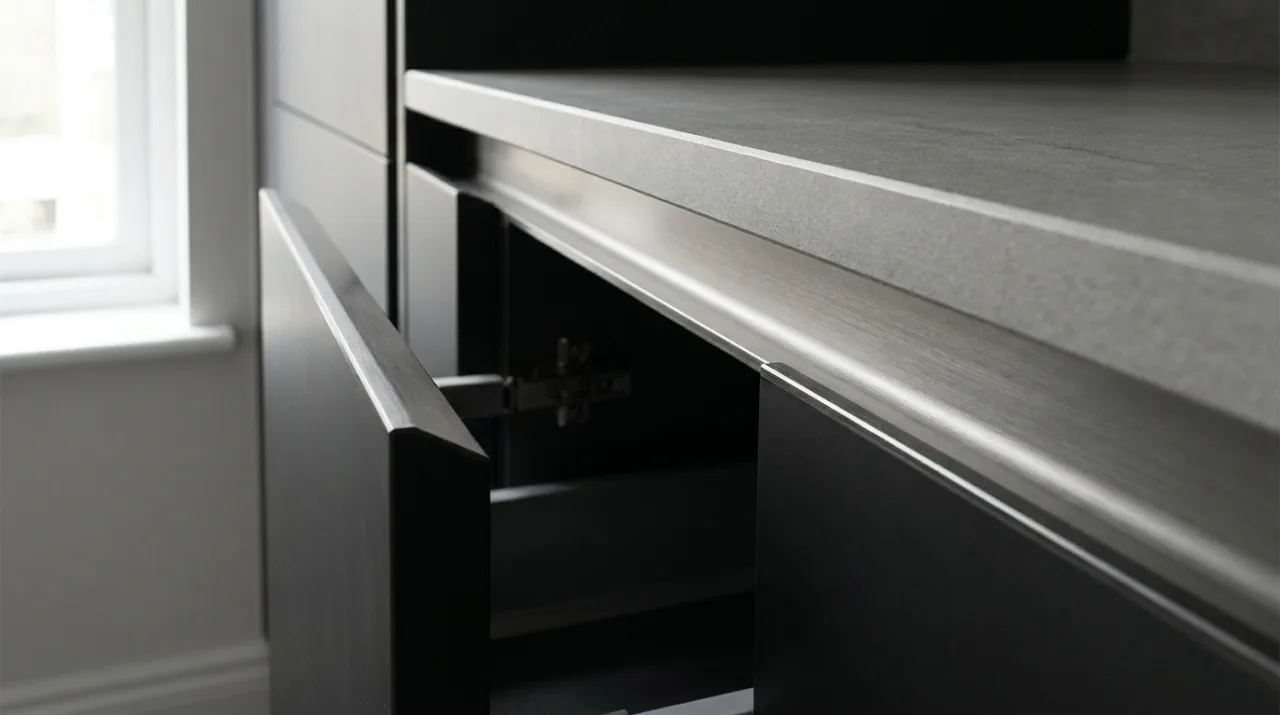
Custom kitchen designed and installed by Osmosis Home in Tangier.
Profile quality: a decisive criterion that price alone does not reveal
Not all stainless steel is equivalent. A thick extruded profile with sufficient wall thickness, a 20-micron finish and precisely engineered mechanical joinery bears no resemblance to a thin, low-cost imported profile whose corners open after a few years of thermal expansion. This is why the choice of manufacturer matters as much as the material itself. At Osmosis Home, we work with partners whose manufacturing processes are documented and controlled: RotPunkt, founded in Germany over a century ago and producing more than 1,500 units per day, guarantees dimensional tolerance standards that few manufacturers can match. This rigour translates directly into the precision of installation and the longevity of the finished work.
Maintaining a stainless steel kitchen: the right approach
One of the strongest arguments in favour of stainless steel is the simplicity of its upkeep. Façades are wiped down with a slightly damp microfibre cloth and a neutral detergent. No abrasive products, no scouring pads: these basic precautions are sufficient to preserve the appearance of surfaces for years. Grease splashes, common near cooking zones, do not penetrate a non-porous surface. For matte or satin finishes, wiping in the direction of the grain prevents visible micro-scratches. The profile corners, which represent the only potential point of vulnerability, require no particular treatment as long as direct impacts are avoided. Compared with solid wood, which requires periodic maintenance, or certain laminates that may delaminate under prolonged exposure to moisture, stainless steel offers a genuinely practical everyday experience.
What stainless steel cannot offer
An honest recommendation requires acknowledging limitations as well. Stainless steel does not provide the visual warmth of a natural wood grain, and certain interiors, particularly those with a wabi-sabi, rustic or traditional Mediterranean sensibility, will call for other materials. The thermal conductivity of stainless steel also means that façades are cold to the touch in winter, which may be unwelcome in some configurations. Finally, a kitchen entirely in stainless steel, poorly proportioned or inadequately lit, can tip into an unintended industrial aesthetic. This is precisely where the design process becomes essential: stainless steel rewards mastery; it does not forgive improvisation.
Viewing completed projects before making a decision
No description can replace the direct experience of a finished installation. Those who wish to form a well-founded view of what stainless steel can achieve in a high-end residential interior are welcome to browse our completed projects in Tangier, which illustrate a range of configurations, volumes and material combinations. For those who prefer to touch the surfaces and discuss their project in person, our showroom is open by appointment at Avenue Abderrahman El Youssoufi, 90,000 Tangier. You are also welcome to visit our Tangier showroom before making any commitment, in order to assess the quality of finishes in a real-world setting.
Conclusion
Stainless steel is today one of the materials best suited to the climatic demands and aesthetic ambitions of a high-end kitchen in Morocco. Its durability, moisture resistance, the variety of available finishes and the ease of its maintenance make it a sound long-term investment: provided that the quality of the profiles, the precision of the design and the care taken in installation are commensurate with the material itself. It is this combination that determines whether a kitchen ages well or poorly. If you have a project in mind, describe your project and our team will guide you from design through to delivery.