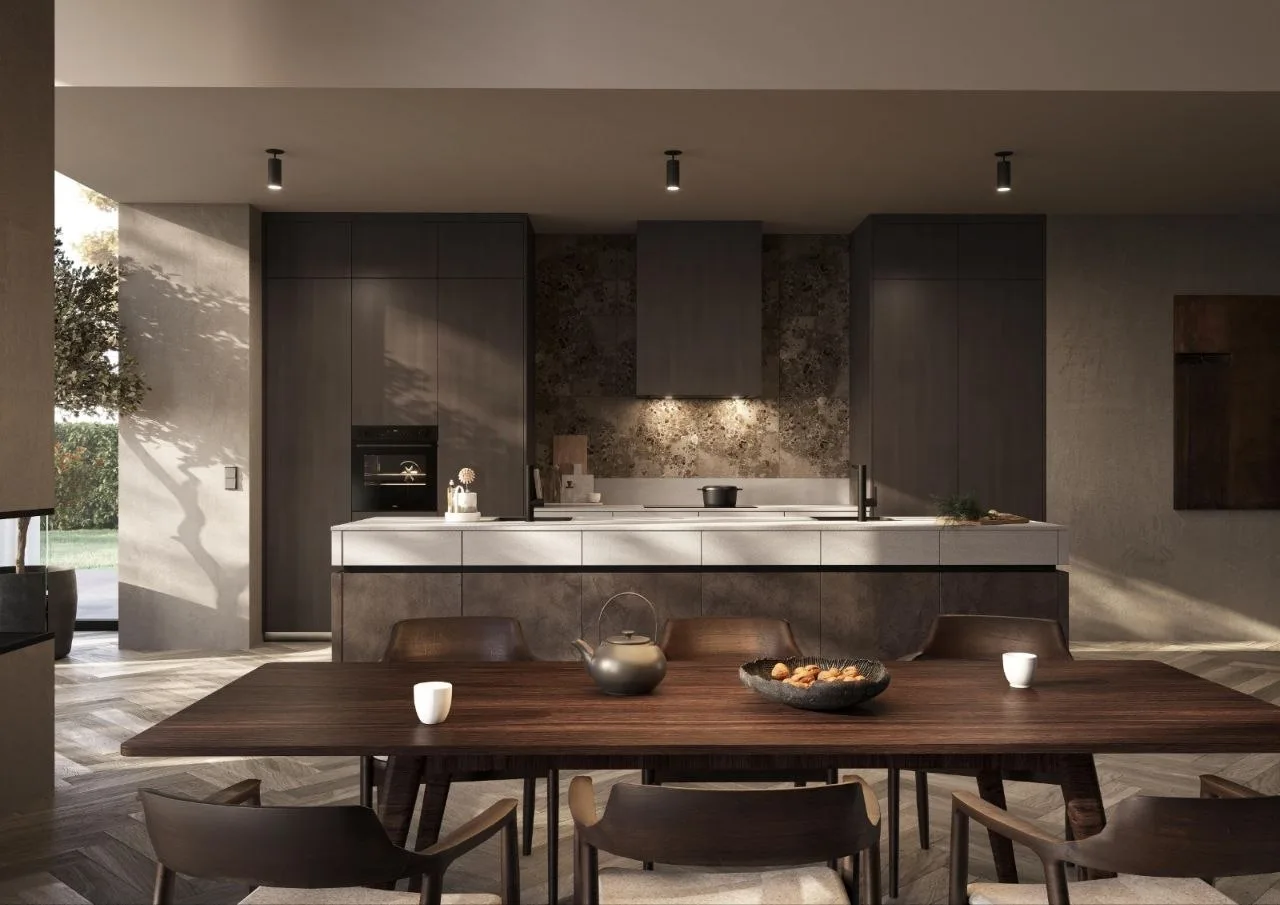
The choice of door material determines both the final aesthetic and the long-term durability of a custom fitted kitchen. In Morocco, two options dominate high-end projects: lacquered MDF and aluminium. One wins over with the warmth of its finishes, the other with its resistance to climatic constraints. Choosing between the two is not simply a matter of taste: it is above all a technical decision, shaped by intended use, the room's environment and the desired level of finish.
A material, a manufacturing logic
MDF (Medium Density Fiberboard) is a panel of compressed wood fibres whose perfectly smooth surface receives a polyurethane lacquer applied in a spray booth. It is this step that gives it its deep colours, its matt, satin or gloss effects, and above all that sense of refined material to the touch. Aluminium, on the other hand, is an extruded profile or a folded sheet, finished by anodising or powder coating. Both processes produce components of great precision, yet they follow different philosophies: MDF belongs to the tradition of cabinet-making, aluminium to that of the aerospace industry and laboratory furniture.
Humidity resistance: the primary criterion in Morocco
In Moroccan kitchens, particularly those close to the Atlantic or Mediterranean coast, ambient humidity is a genuine constraint. Moisture-resistant MDF, treated throughout its core against humidity, withstands moderately damp environments without warping or swelling. It remains, however, sensitive to repeated water splashes and poorly maintained seals around the sink. Aluminium is inherently unaffected by water: it does not swell, does not warp and never deteriorates. For a kitchen that opens onto a terrace, a secondary residence occupied seasonally, or a space with insufficient ventilation, aluminium offers a peace of mind that MDF cannot always guarantee.
Aesthetics: two distinct worlds
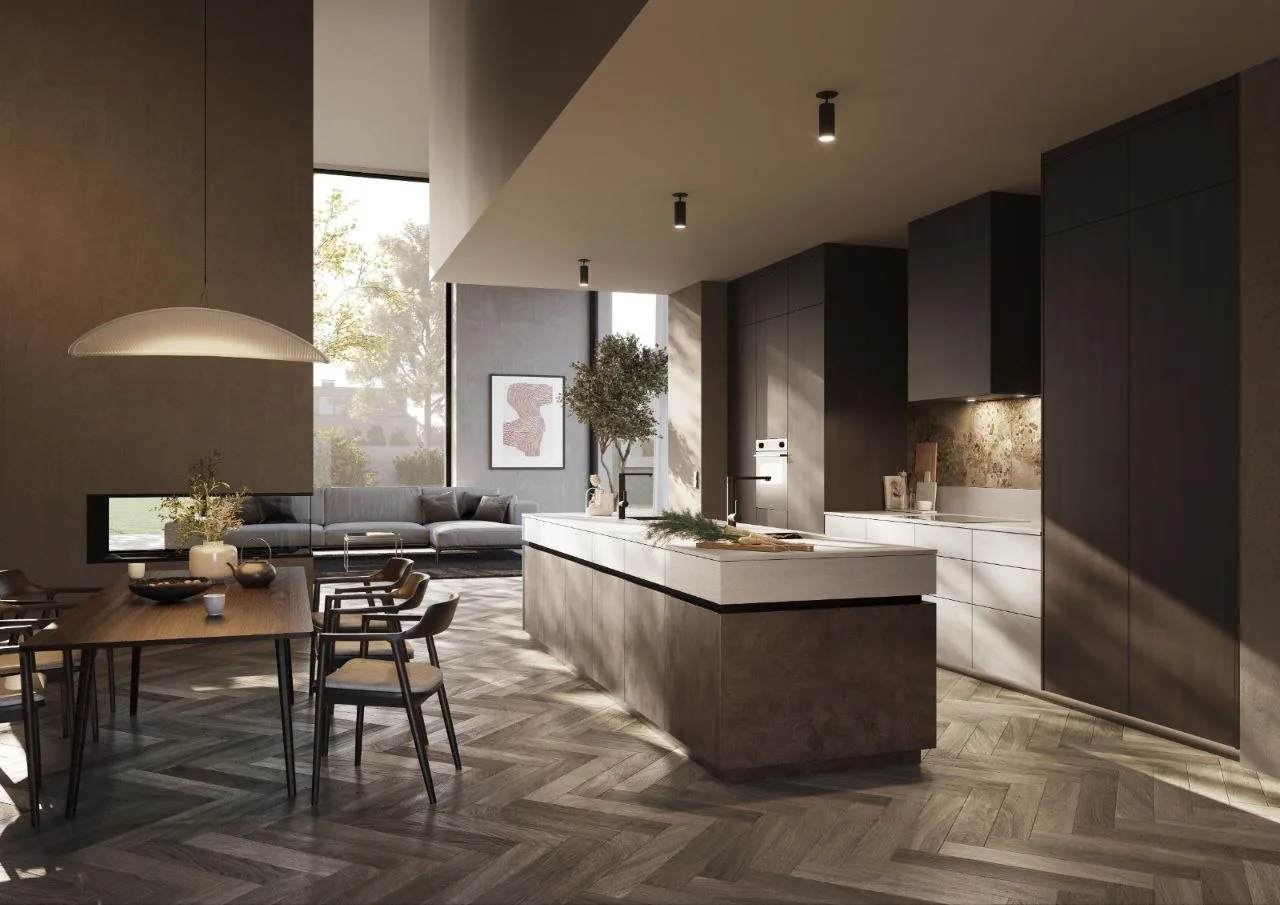
Lacquered MDF offers a virtually unlimited colour palette, reproduced with remarkable accuracy using RAL or NCS references. Its continuous surface, with no visible joint across the doors, creates the monolithic effect sought in clean contemporary kitchens. Velvety matt or satin finishes absorb light differently depending on the time of day, giving it a visual presence that few materials can match. Aluminium, for its part, imposes its own formal vocabulary: clean lines, sharp angles, a slightly metallic or industrial matt effect depending on the surface treatment. It integrates naturally into interiors with grey, anthracite or champagne tones, and pairs elegantly with polished concrete, glass or stainless steel. The two materials even coexist in certain projects, where aluminium structures the uprights while MDF clads the storage doors.
Long-term behaviour
Quality MDF, fitted by a professional and properly maintained, lasts twenty years and beyond. Edges remain the most vulnerable area: repeated impacts can chip the lacquer along the arris. Some manufacturers offer thermoformed ABS edging, which absorbs knocks without cracking. Aluminium is resistant to both minor impacts and everyday wear; its anodised finish withstands scratching better than lacquer. A deep deformation, however, is difficult to repair locally: the door often needs to be replaced entirely. MDF, by contrast, can benefit from a lacquer touch-up for minor imperfections, provided the colour match is exact.
Weight and installation
Aluminium is significantly lighter than MDF for an equivalent surface area, which makes handling large doors considerably easier, a notable advantage when the kitchen includes floor-to-ceiling columns or long kitchen islands. Cutting and assembling aluminium requires specific tooling and expertise in profile systems, which explains why not all kitchen designers offer it. MDF is more universally handled during installation, but demands a properly equipped spray booth to guarantee a uniform result free of runs or surface defects. In both cases, the quality of the workshop and the installation makes the difference between an average result and an exceptional one. For further detail on the characteristics of aluminium doors within a complete project, our article on aluminium kitchens in Morocco covers the configurations best suited to each context.
What the budget reveals
Lacquered MDF generally remains more affordable than aluminium for an identical door surface area, although the gap narrows considerably when comparing equivalent ranges. A large-format high-gloss MDF door costs more than a standard matt aluminium one. The overall budget of a kitchen is not limited to the doors: the carcass, hardware, worktop and integrated appliances represent an equally significant share. Our guide on fitted kitchen prices in Morocco presents realistic figures observed on recent projects, including materials and labour. This broader budget perspective allows for a more informed choice between the two materials, rather than focusing solely on the cost of the doors.
The worktop: an element of overall coherence
The door material directly influences the choice of worktop. A kitchen in white or pearl grey lacquered MDF naturally pairs with a veined white quartz surface, Dekton or matt porcelain stoneware. An anthracite aluminium kitchen calls instead for polished concrete, brushed stainless steel or dark natural stone. This coherence is not an arbitrary aesthetic constraint: it reflects a material logic that makes the whole credible and considered. Our dedicated article on kitchen worktops in Morocco reviews the materials available locally, their prices and their behaviour in use, so that this choice can be integrated from the very beginning of the design process.
Our recommendations based on your situation
For a primary residence in Tangier or in a city with high humidity levels, quality moisture-resistant MDF remains an excellent choice provided the installation is flawless and the room's ventilation is adequate. For a secondary residence, a holiday home or a kitchen-living space with significant exposure, aluminium naturally prevails through its durability and low maintenance requirements. In both cases, the quality of the hardware (pull-out rails, soft-close dampers, storage systems) matters just as much as the door material. Osmosis Home works with RotPunkt, a German manufacturer whose mechanisms are designed to last for several decades, and with In-Ipso, a recognised French partner known for the refinement of its carcasses and the precision of its assemblies. Concrete examples of these projects can be found in our showroom in Tangier, Avenue Abderrahman El Youssoufi, where both materials are displayed in real-life configurations.
Conclusion
MDF or aluminium: the answer is not universal: it is specific to each project. What matters is the match between the chosen material, the kitchen's environment, daily use and the aesthetic ambitions of the space. A well-conceived kitchen combines technical rigour in every detail with visual coherence throughout, two qualities that emerge from thorough design work, long before construction begins. If you would like a knowledgeable advisor to assess your configuration and guide you towards the most appropriate solution, you are welcome to describe your project and we will respond with a proposal tailored to your space and expectations.