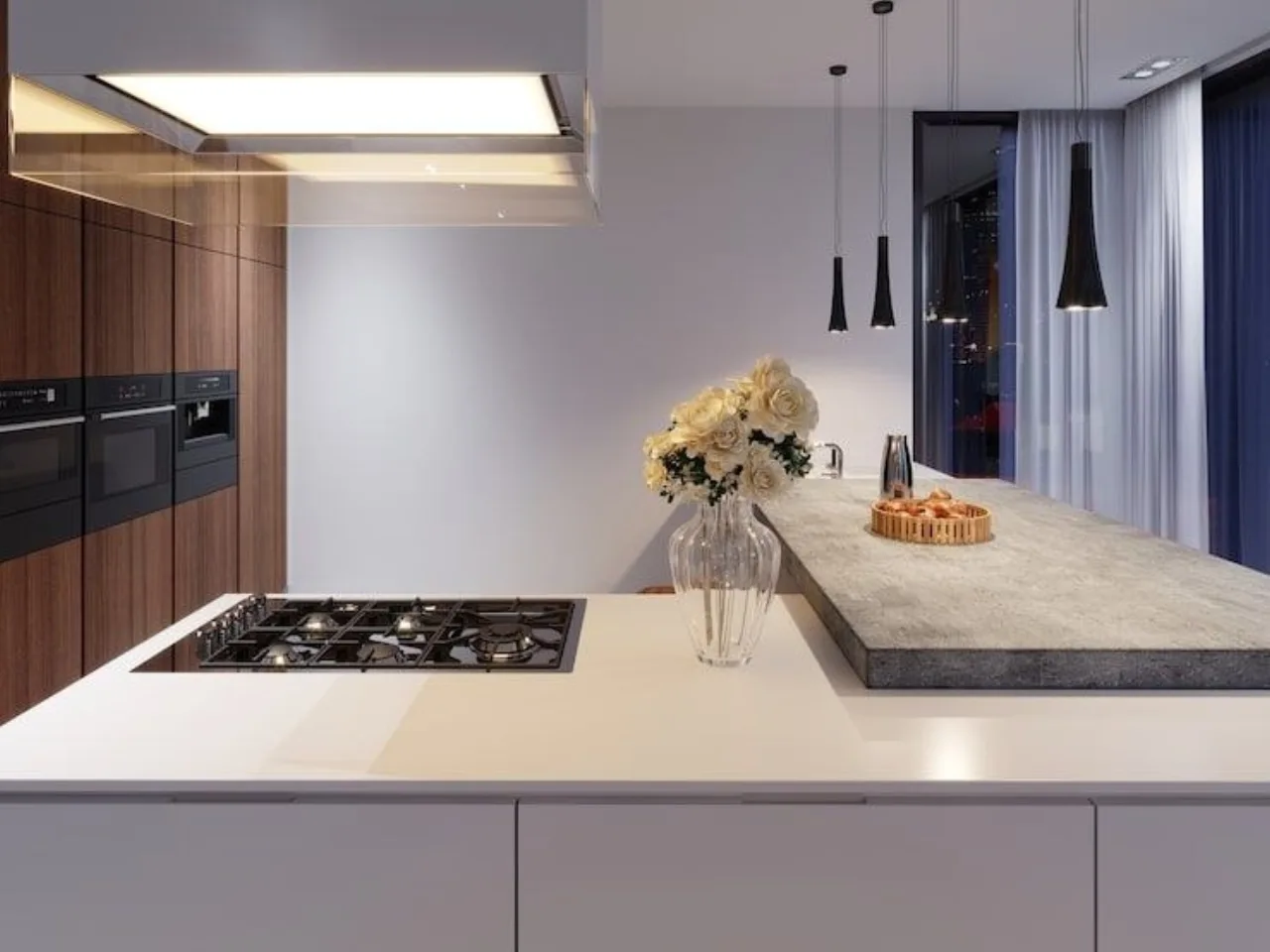
The kitchen is no longer merely a functional space: it has become the visible heart of the home, the place where a way of life is expressed most clearly. For those wishing to entrust this project to expert hands, a custom-designed fitted kitchen now represents the most fitting answer, one that reconciles aesthetic refinement, considered ergonomics and lasting materials. In Morocco, this aspiration toward high-end living is taking on an increasingly defined shape, driven by a clientele that is no longer satisfied with off-the-shelf solutions.
A New Way of Living in the Kitchen
The defining trend running through 2026 is that of spatial continuity. The kitchen ceases to be a closed room, folded in on itself, and opens instead onto the living room or dining area in a fluid, uninterrupted movement. This evolution is not merely architectural: it demands total coherence between the finishes of the kitchen and those of the rest of the home. Cabinet fronts, worktops and splashbacks must converse with floors, walls and joinery. It is this holistic thinking that distinguishes a well-conceived project from a simple furniture purchase.
Structured Aluminium and Natural Wood: Two Poles of the Same Demand
In terms of cabinet fronts, two directions stand out this year with particular clarity. On one side, structured aluminium, precise profiles, uncompromising resistance, a capacity to endure over time without ever warping or delaminating. On the other, natural or veneered wood, with its grain, warmth and that calculated imperfection which brings a space to life. These two worlds are not in opposition: the most successful projects combine them, reserving aluminium for large storage areas and wood for islands or front panels that call for a softer presence. The result is a kitchen that belongs to no fixed style, but constructs one entirely its own.
The Colours That Redefine White
White will always remain a solid foundation, but 2026 favours more complex tones. A slightly creamy off-white, a warm-undertoned light grey, a deep grey-green or a discreet slate blue: these shades are chosen not for their spectacular originality, but for their ability to age with elegance and to create a neutral backdrop that enhances noble materials. Matte lacquer takes precedence over gloss, less prone to marks and more in keeping with a restrained interior. These chromatic choices follow a single logic: a kitchen that does not overwhelm the eye, but soothes it.
The Worktop: The Centrepiece of the Project
No decision in a kitchen carries as much weight as the choice of worktop. It is at once a daily working surface, a central aesthetic element and an indicator of the overall level of finish. In 2026, natural stone (marble, quartzite, granite) holds a position of prominence. Its ability to endure without ever going out of fashion, its resistance to thermal shock, and above all the singularity of each slab make it a choice that is difficult to surpass. For those seeking a more technical alternative, large-format porcelain stoneware faithfully reproduces the veining of stone while offering greater resistance to stains and acids. Solid wood, meanwhile, suits spaces where the worktop is subjected to less intensive use, a secondary preparation island, for instance.
Appliance Integration: Coherence Down to the Last Detail
The trend toward fully integrated appliances shows no sign of slowing. Refrigerators, ovens, dishwashers and extractor hoods disappear behind cabinet fronts, indistinguishable from storage units in a logic of visual continuity. This approach requires highly precise upstream design work: every dimension must be conceived to accommodate the appliances without compromise on ergonomics or on the effective depth of storage. This is one of the key reasons why bespoke solutions prevail over standard ones: they alone can absorb the real constraints of a space without circumventing them.
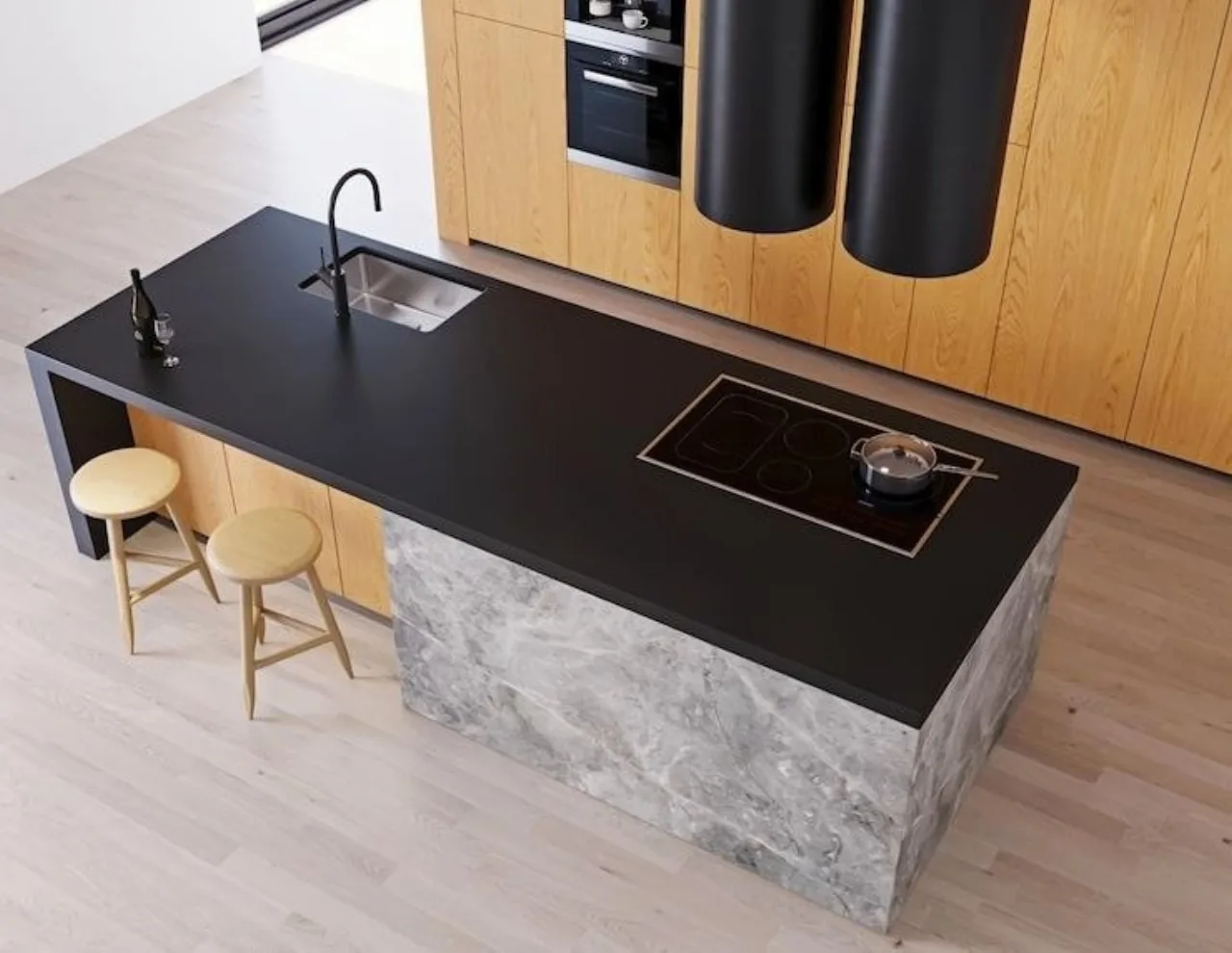
Osmosis Home Project : open-plan custom kitchen, oak veneer fronts and quartz worktop, Tangier 2026.
Understanding the Investment Before You Begin
A custom modern kitchen project should not be approached without a clear understanding of price ranges and what they actually encompass. The gap between a standard lacquered MDF kitchen and an aluminium installation with a natural stone worktop is considerable, and entirely justified by longevity, manufacturing precision and the quality of the hardware. For anyone wishing to calibrate their project, our guide on the budget for a fitted kitchen in Morocco details the product tiers, the key cost items and the trade-offs to consider according to the available space.
What "Bespoke" Means in Tangier
Bespoke in Tangier is not limited to adjusting the dimensions of a standard piece of furniture. It is a complete project-based approach, beginning with a site visit, a thorough understanding of actual usage patterns, an analysis of architectural constraints (ceiling height, duct positions, existing openings) and culminating in a design entirely dedicated to that space and its occupants. Osmosis Home articulates this around carefully selected manufacturing partners chosen for their industrial precision: RotPunkt, founded over a century ago in Germany, produces up to 1,500 units per day with consistent accuracy, while In-Ipso, a French house, brings a sensitivity to finishes and hardware details that is felt in everyday use. To better understand what this means in practice at the scale of a city, we have dedicated a full article to bespoke kitchens in Tangier.
Interior Coherence, Beyond the Kitchen
A high-end interior is rarely built room by room, in isolation from its surroundings. Clients embarking on a modern kitchen project often think simultaneously about the bathroom, the dressing room and storage spaces throughout the home. This holistic vision is both sound and productive: the materials, tones and design principles chosen for the kitchen can be extended elsewhere with coherence. Our article on high-end bathroom materials addresses this same logic of rigorous material selection, applicable across the entire project. And for a concrete view of completed work, the section dedicated to our completed projects illustrates the breadth and level of excellence brought to each commission.
Conclusion
The custom modern kitchen in Morocco is no longer a luxury reserved for a select few: it is a considered decision, made by people who understand that the quality of materials, the precision of design and the reliability of manufacturing partners determine the true long-term value of an interior. The trends of 2026 confirm this orientation toward deliberate restraint, spatial continuity and the enduring presence of noble materials. If you wish to begin this reflection for your own space, the Osmosis Home team welcomes you at its showroom on Avenue Abderrahman El Youssoufi in Tangier, or is available to answer your questions online. Describe your project and we will guide you from the very first steps.