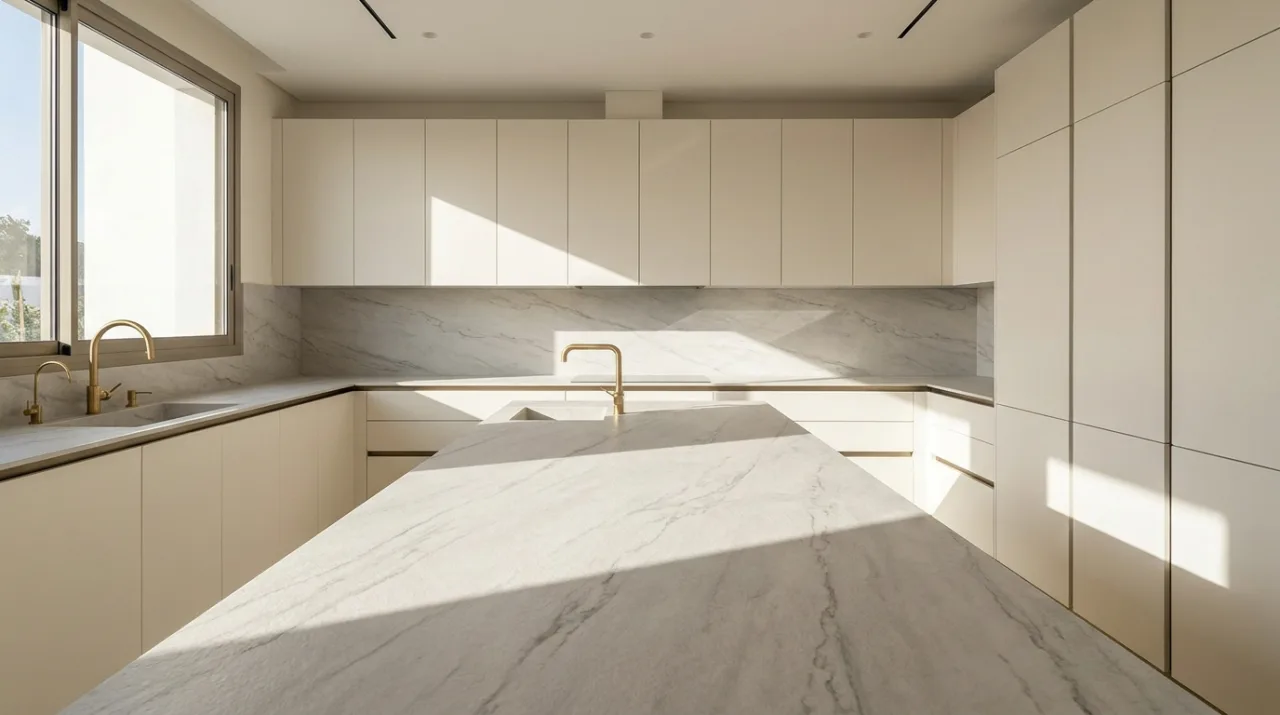
The worktop is one of the most defining decisions in any kitchen project. It shapes the overall aesthetic, determines how well the space holds up to daily use, and accounts for a significant share of the budget. Before settling on a choice, it is worth understanding what each material truly involves: not only in terms of price, but also maintenance, long-term behaviour, and how well it aligns with the rest of your bespoke fitted kitchen project. That is precisely what this article sets out to clarify, drawing on what we observe day to day across the projects we carry out in Tangier and throughout Morocco.
Why the choice of worktop deserves careful consideration
In a kitchen, the worktop is the most heavily used surface. It absorbs the heat of pots and pans, the repeated impact of knives, the moisture from washed vegetables, and stains from coffee or saffron. An unsuitable material reveals its shortcomings quickly: visible scratches after just a few months, blackened joints, surfaces that dull or crack under steam. Conversely, a well-chosen worktop remains intact and beautiful for decades. It is an investment, not a line item to be cut.
Laminate: the accessible option, with its limitations
Laminate is the most widespread worktop material in Morocco, particularly in budget-conscious projects. It consists of a particleboard core covered with a high-pressure resin sheet, available in a wide range of finishes: wood, concrete, stone effects or solid colours. Its price generally ranges from 300 to 700 dirhams per linear metre, installation included, depending on thickness and finish quality.
Its limitations are real: laminate is vulnerable to deep scratches, direct heat and moisture at the edges, particularly at the junction with the sink. In a high-end project, it is rarely selected, precisely because these weaknesses appear too quickly to justify the standards expected of a bespoke kitchen.
Solid wood: natural warmth and regular upkeep
Solid wood, beech, oak or teak, depending on the project, brings an organic warmth that synthetic materials struggle to replicate. It suits kitchens with a crafted sensibility, or contemporary Scandinavian and rustic aesthetics particularly well. Its price ranges from 1,200 to 2,500 dirhams per linear metre for quality wood, supplied, fitted and oiled.
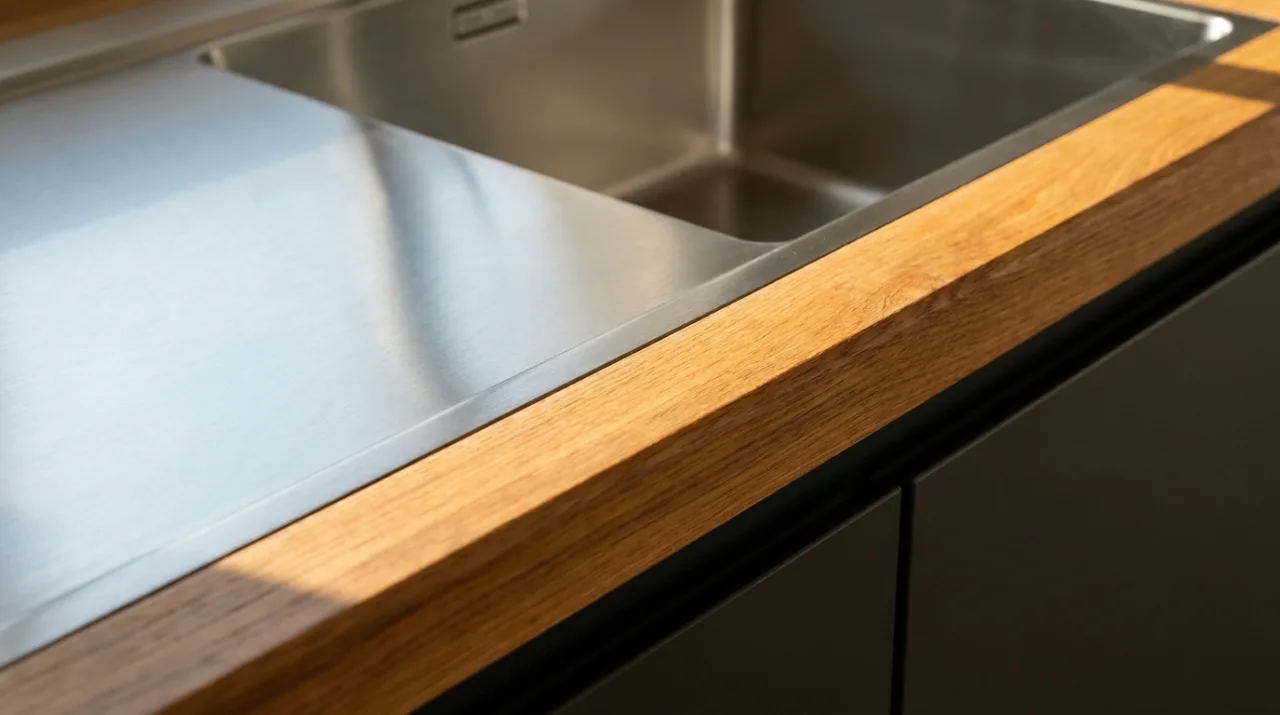
Maintenance is a point that should not be underestimated: wood must be oiled regularly, cannot tolerate standing water, and requires protection near the sink through a stainless steel insert or a specific treatment. It is a living material that develops a patina over time: some find that quality deeply appealing; others find it equally off-putting.
Stainless steel: absolute performance, industrial aesthetic
Stainless steel is the material of professional kitchens, and its use in high-end residential settings has steadily grown, particularly in projects with a contemporary or industrial character. Its resistance to heat, moisture and bacteria is unmatched. It withstands knives, dishes straight from the oven, and constant contact with water.
In its residential form, brushed food-grade stainless steel at 1.2 mm, pricing ranges from 2,000 to 4,000 dirhams per linear metre, depending on thickness, surface treatment and cutouts required. Brushed stainless steel is preferable to polished, as the latter reveals every fingerprint. It is a bold choice, one that visually anchors the entire kitchen around it.
Large-format ceramic and porcelain: elegance and robustness
Large-format ceramic, slabs of 120 × 60 cm or more, in glazed stoneware or full-body porcelain, has established itself as one of the most coherent options for premium kitchens in Morocco. It resists scratches, thermal shock and staining, and its upkeep requires nothing more than a simple wipe. Visually, it allows the wall tiling to extend seamlessly onto the worktop, creating a particularly refined aesthetic continuity.
Prices vary according to the origin of the slabs and their thickness: between 1,500 and 3,500 dirhams per linear metre for professional installation including sink and hob cutouts. The installation itself demands a skilled craftsman: joints and overhangs must be treated with precision to prevent any water ingress. It is also the ideal moment to consider the kitchen splashback, which can echo the same material for a fully unified result.
A worktop conceived as part of a coherent whole: materials, proportions and installation details come together seamlessly.
Quartz and natural stone: the top of the range
Engineered quartz, composed of approximately 90% natural quartz bound with resin, is arguably the most sought-after worktop material in premium projects. It combines the hardness of stone, stain resistance superior to marble, and a visual consistency that natural stone cannot always guarantee. Its price ranges from 3,000 to 6,000 dirhams per linear metre, depending on thickness and brand.
Natural marble remains an exceptional material, but it absorbs acids (lemon juice, vinegar) and scratches more readily than quartz. It is better suited to partial decorative use: a central island, a niche, a shelf. For a primary worktop subject to intensive daily use, quartz remains the most sensible high-end choice. Prices for imported marble range from 4,000 to 9,000 dirhams per linear metre, depending on origin and the rarity of the veining.
Aluminium kitchens: thinking through material coherence
When a project incorporates aluminium cabinetry, an increasingly popular choice for its durability and contemporary finishes, the worktop must be considered in direct relation to it. A restrained ceramic or quartz surface pairs naturally with anodised aluminium. Conversely, solid wood can create an interesting contrast, provided the project fully commits to that tension. To explore this question of material coherence further, our article on aluminium kitchens in Morocco details the most successful combinations we have encountered.
How to budget for a worktop within a complete project
The worktop typically accounts for between 8 and 15% of the total budget for a fitted kitchen, depending on the material chosen. In an 80,000-dirham project, that places the range between 6,400 and 12,000 dirhams, excluding installation and special cutouts. These figures vary according to the total length, the number of cutouts required (sink, integrated hob), and edge treatment: a bevelled or rounded stone edge represents an additional 200 to 400 dirhams per linear metre.
For a clear overview of your project's overall budget, our article on the price of a fitted kitchen in Morocco offers a comprehensive breakdown by cost category. It is always preferable to work through these decisions with a professional who understands the local constraints around sourcing and installation.
Come and see the materials in a real setting
Reading descriptions of materials is no substitute for the tactile experience. The difference between a matt quartz and a polished ceramic, between brushed and satin-finish stainless steel, is felt through touch, in the actual light of a kitchen. That is precisely why we encourage our clients to visit our showroom on Avenue Abderrahman El Youssoufi in Tangier, where surfaces are presented within complete kitchen configurations: not as abstract samples on a display rack.
Conclusion
The worktop is neither a minor detail nor a line item to be compromised at the last moment. It determines the longevity of your kitchen, its visual coherence and your daily comfort for years to come. Accessible laminate, warm solid wood, high-performance stainless steel, refined ceramic, quartz or natural stone for the most ambitious projects: each material follows its own logic, and the best choice is the one that fits seamlessly within the overall vision of your project. At Osmosis Home, we guide this process from the very first stages, so that every decision is both beautiful and right. If you have a project in mind, describe your project and we will get back to you promptly.