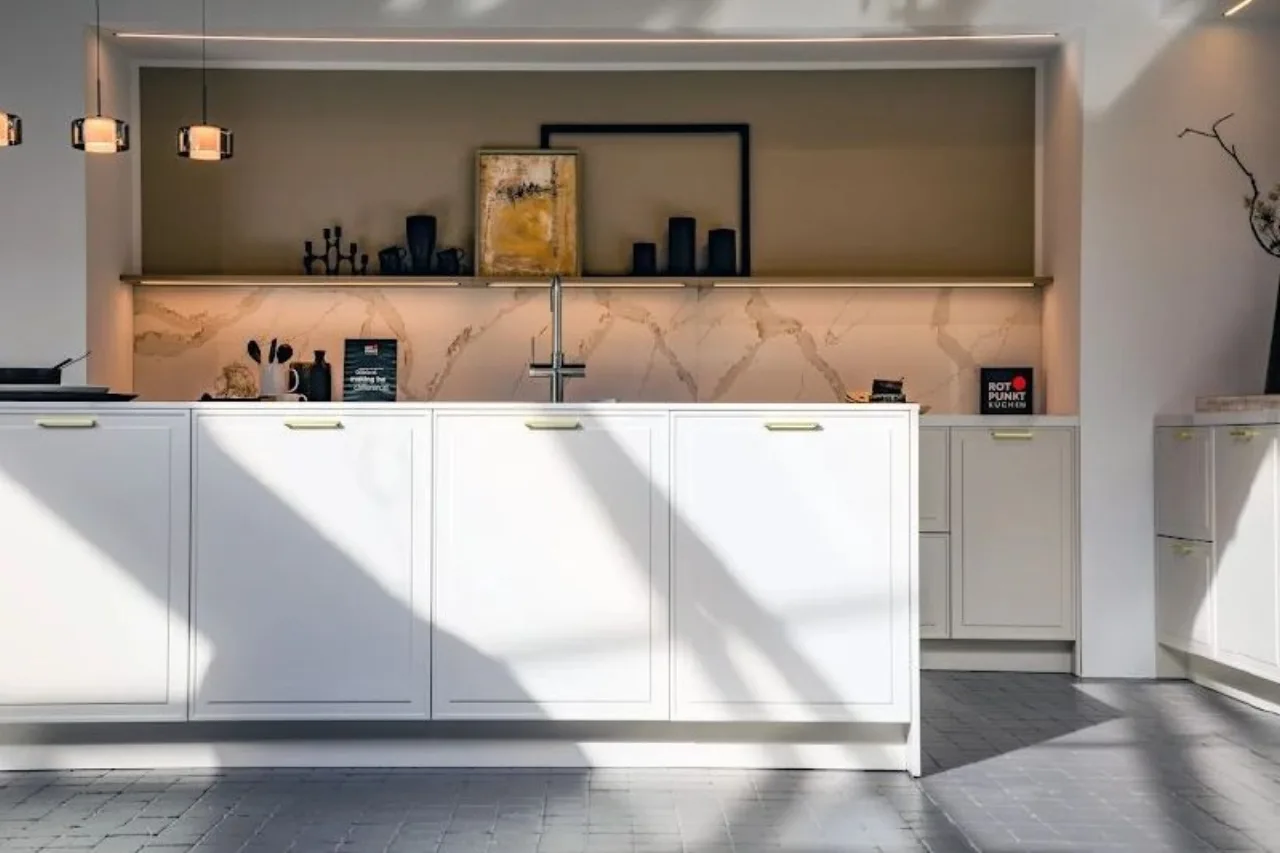
The price of a fitted kitchen in Morocco is one of the first questions asked by homeowners considering a renovation or new build. It is not a straightforward question, and any honest answer must begin with context. For a bespoke fitted kitchen, designed with premium materials and European hardware, the variables are numerous and each one has a real impact on the final budget. This article gives you the concrete benchmarks you need to approach your project with clarity.
Why prices vary so greatly from one project to another
The question of price only makes sense in relation to what you are actually buying. A kitchen at 20,000 dirhams and a kitchen at 150,000 dirhams share, in truth, almost nothing in common: not the facade material, not the robustness of the carcasses, not the quality of the fittings, nor the expected lifespan. The Moroccan market is defined by this tension between entry-level offerings frequently marketed as "fully fitted" and genuinely high-end installations. Understanding that difference is already an informed choice in itself.
The cost components of a fitted kitchen
A kitchen breaks down into several cost categories that must be distinguished in order to establish a realistic budget. Carcasses and facades typically represent the largest single item: their material, thickness, resistance to moisture and impact determine how well the kitchen holds up over time. Next comes the worktop, whose prices vary considerably depending on whether it is laminate, quartz, granite or large-format ceramic. Built-in appliances (oven, hob, extractor hood, dishwasher) represent a third cost category that is often underestimated in initial estimates. Finally, installation, delivery and site finishing are real costs that some quotes conceal in order to appear more competitive.
Price ranges observed in Morocco
As a guide, a lacquered MDF fitted kitchen with standard appliances for a linear surface area of 8 to 12 m² typically starts at around 30,000 to 50,000 dirhams in the mid-range segment. For a high-end kitchen, with brushed or matt-lacquered aluminium facades, a quartz or ceramic worktop, and soft-close mechanisms, budgets more commonly fall between 80,000 and 200,000 dirhams depending on the surface area and chosen appliances. These figures apply to a Tangier kitchen delivered and installed, excluding any preliminary plumbing or electrical work. It is essential never to compare two quotes without first ensuring they cover exactly the same scope of work.
The role of materials in the overall cost
The choice of material alone can double or triple a kitchen budget. Moisture-resistant MDF remains the most widely used base material in Morocco; it offers a good finish-to-price ratio when properly executed. Aluminium, by contrast, represents a significantly higher investment but delivers rigidity, impact resistance and longevity that MDF cannot match over time. Solid wood or wood-veneered facades occupy a distinct register, enhancing interiors with their natural warmth and unique character. Large-format ceramic worktops, often referred to as porcelain stoneware, are currently in high demand for their resistance to heat and water, as well as for their formats that minimise the number of joints.
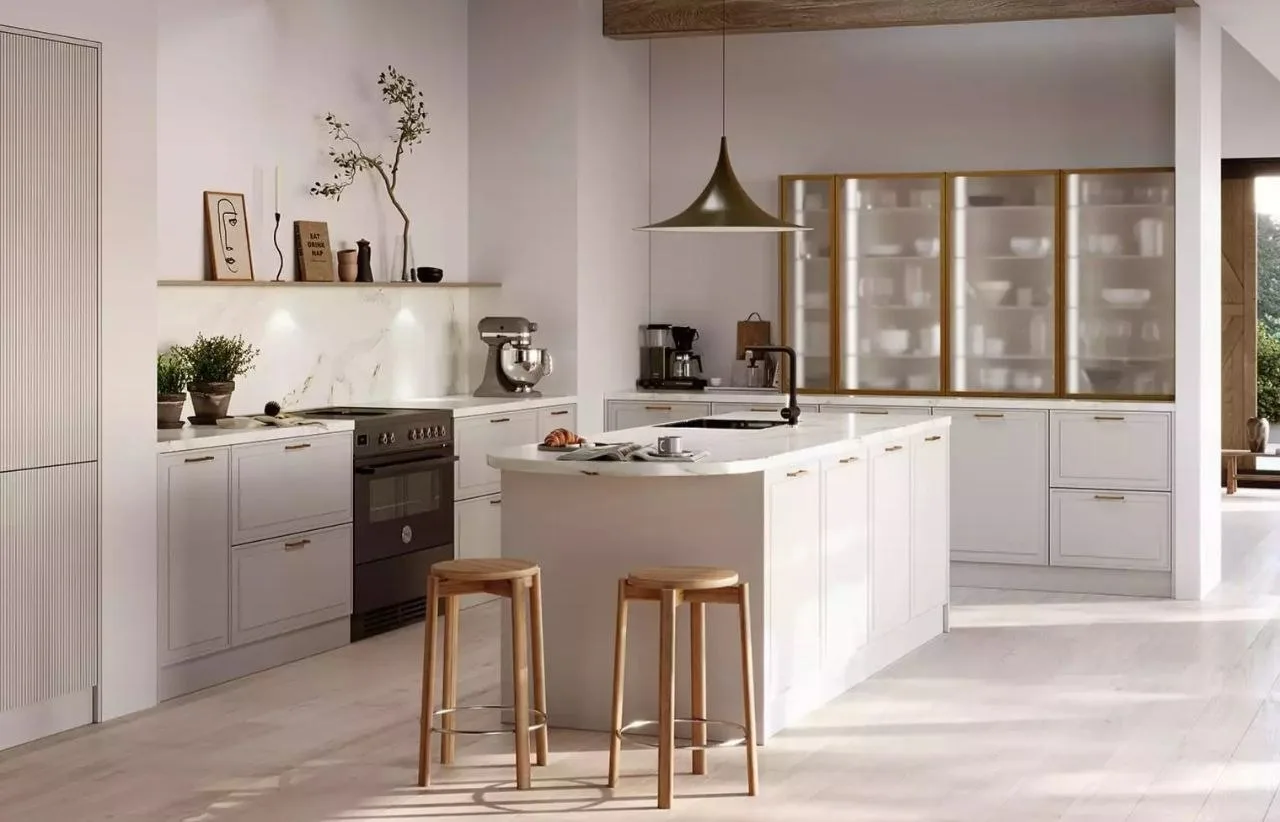
Aluminium facades and ceramic worktop: two material choices that define both the aesthetic and the budget of a kitchen project.
Bespoke or standard: a decisive distinction for the budget
Many fitted kitchen projects in Morocco start from a principle of standardisation: fixed-dimension carcasses are selected and the space is adapted around them. This approach allows for short-term savings but frequently results in wasted space, awkward finishes at corners, and an aesthetic that lacks coherence. Bespoke design, by contrast, exploits every available centimetre, perfectly integrates architectural constraints, and delivers a result that the owners of a truly custom kitchen recognise immediately: the space feels larger, better organised, and more considered. The additional cost of bespoke work is real, but it is offset by the significantly longer lifespan of the installation.
What European partner manufacturers guarantee
The origin of materials and systems has a direct bearing on price, but also on perceived and real quality over time. Osmosis Home works with RotPunkt, a German manufacturer with over a century of history, producing some 1,500 units per day in its workshops. This industrial capacity is accompanied by strict environmental certifications and a standard of finish that entry-level local manufacturers cannot achieve. In-Ipso, a French partner, complements this offering with lines of a more contemporary aesthetic. Incorporating these brands into a project implies a higher budget than a non-certified local solution, but that is precisely what justifies it as an investment rather than an expense.
How to obtain a fair and complete quote
A proper kitchen quote details each cost item separately: supply of carcasses, facades, worktop, hardware, installation, finishes and appliances if included. Be wary of lump-sum quotes with no breakdown, which make any serious comparison impossible. The surface area to be fitted, ceiling height, number of full-height units, the presence of an island or a dining area: all of these elements materially affect the final figure. We invite you to visit our showroom in Tangier, Avenue Abderrahman El Youssoufi, where our kitchens are displayed at full scale and where our teams can provide you with a precise estimate from your very first meeting.
Kitchen prices in Tangier versus other Moroccan cities
Price differences exist between Morocco's major cities, driven by transport costs, the density of local supply and the average purchasing power of each client base. Tangier, well connected to Europe and home to a discerning expatriate and overseas Moroccan clientele, is experiencing growing demand for high-end kitchens. This dynamic raises the overall standard of work, but it also means that the value-for-money proposition must be impeccably justified. If you wish to explore the concrete possibilities that bespoke design opens up in Tangier, our article on bespoke kitchens in Tangier details the specificities of the local market and the most sought-after finish choices.
What Moroccan families are looking for today
The expectations of Moroccan households when it comes to kitchens have evolved profoundly in recent years. The open-plan kitchen integrated with the living room, long uncommon in traditional interiors, has become standard in modern apartments and newly built villas. This shift creates a new aesthetic demand: the kitchen must be as refined as the rest of the living space, because it has now become part of it. Families returning from abroad are knowledgeable about materials and brands, and they can readily distinguish a well-machined facade from one that begins to peel within three years. To discover how this trend translates into recent Osmosis Home projects, you can read our article on modern bespoke kitchens in Morocco and the aesthetic directions that are defining them.
Conclusion
The price of a fitted kitchen in Morocco can never be reduced to a single figure. It reflects choices of materials, manufacturers, approach, bespoke or standard, and level of finish that every family makes according to their own priorities. What distinguishes a successful project from a disappointing one is rarely the budget itself: it is the clarity with which that budget has been allocated. A kitchen that lasts twenty years and never makes you want to replace it is almost always one in which the investment was made properly from the outset. To go further, you can browse our completed projects in Tangier and across Morocco to see concretely what these choices look like in reality. And if you are ready to take the next step, we invite you to describe your project and request a personalised estimate, our team will get back to you promptly.