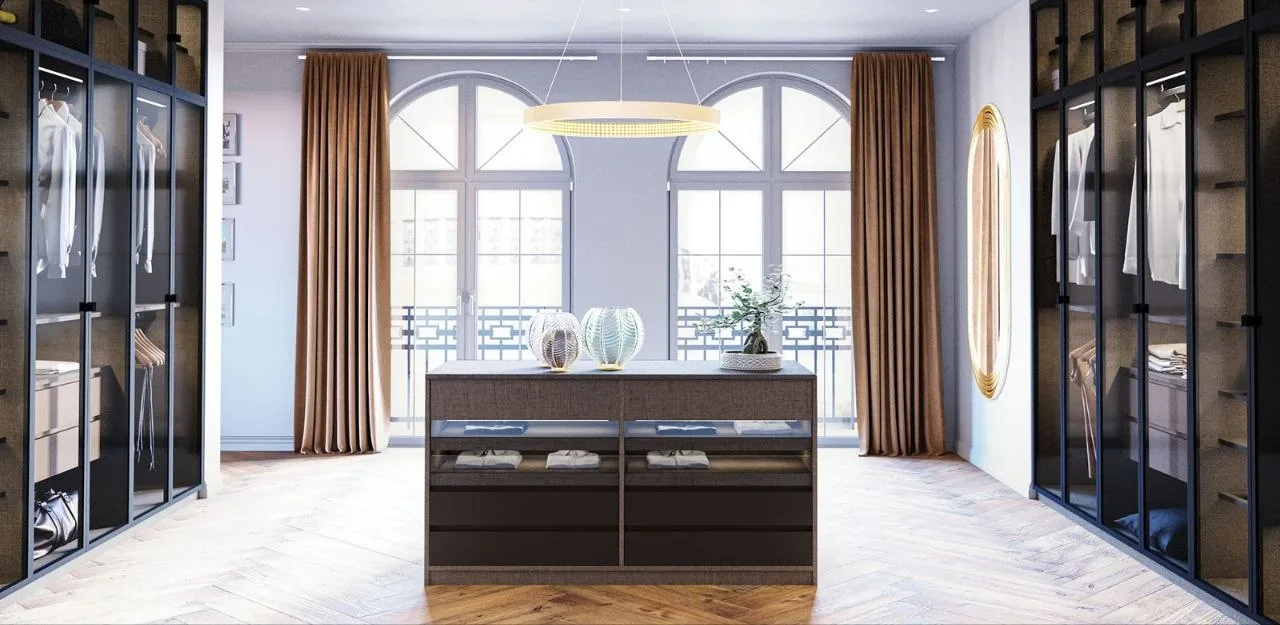
Designing a custom wardrobe in Morocco is a decision that involves a budget, a choice of materials, and a precise vision of what you want for your interior. For those looking to optimise a master bedroom, structure a hallway, or make use of attic space, the question of cost invariably comes first. This guide explores the realities of the Moroccan market, the factors that cause prices to vary, and what sets a custom wardrobe designed for the long term apart from a standard solution purchased at a large retailer. The aim is not to provide a universal figure, none exists, but to allow each project to be assessed with accuracy.
Why prices vary so much from one project to another
The first thing to understand is that a custom wardrobe is not a catalogued product. It is born from a particular configuration: a 2.40-metre alcove does not call for the same solutions as a dedicated dressing room of 9 square metres. Ceiling height, the presence or absence of a window, the nature of the load-bearing partition, access to natural light : all of these parameters influence the design before materials are even considered. It is this work of adaptation that constitutes the fundamental value of bespoke craftsmanship and justifies the price difference compared to ready-to-install ranges.
Materials and their impact on the budget
The choice of material is the most direct lever on the final cost. At the entry level, melamine-faced panels offer a decent finish for a contained budget, but they have limitations in terms of long-term durability and aesthetics. Lacquered MDF represents a step up: its uniform surface accepts contemporary matte tones perfectly, from off-white to deep grey, and lends itself to more refined door profiles. At the premium level, high-gloss lacquers, genuine wood veneers (walnut, oak, ash) or anodised aluminium fronts bring an architectural dimension that entry-level materials cannot replicate. Osmosis Home works with manufacturing partners such as RotPunkt, a German manufacturer founded over a century ago, whose rigorous production standards translate directly into the quality of hinges, runners and edge finishes.
Price ranges in Morocco: what to anticipate
In Tangier, as in other major Moroccan cities, custom wardrobe projects generally range from 8,000 to 15,000 dirhams for a compact configuration in standard MDF, without integrated sliding doors. Once you move towards finer materials, motorised opening systems, integrated LED lighting, or specialist storage accessories (rotating tie racks, jewellery drawers, fold-away valets) the investment typically falls between 20,000 and 50,000 dirhams. For a master bedroom wardrobe in a high-end apartment or villa, complete projects frequently exceed this threshold, without being excessive given the lifespan and daily use of such a fitting. Installation, finish carpentry and any preparatory work account for an average of 20 to 30% of the total budget and must be factored in from the initial estimate.
Open wardrobe or with doors: a choice that matters for the budget
The question of access deserves particular attention, as it significantly affects the overall budget. A wardrobe without doors, designed as an open recess or dressed with a curtain, costs less to produce, but it requires in return a disciplined approach to organisation and perfect visual consistency, since everything is permanently on display. Sliding doors, on the other hand, represent a significant cost: models in smoked glass, mirror, or matte lacquer require a quality rail, soft-close end buffers, and millimetre-precise alignment. To understand how this choice influences not only the price but also day-to-day practicality, our analysis of the comparative advantages of sliding doors and open wardrobes in Morocco details the key trade-offs.
The influence of dimensions and spatial configuration
A wardrobe is not measured in linear metres alone. The depth of the carcasses, standard at 55 or 60 cm for hanging garments, determines how much space is taken up in the room. Floor-to-ceiling height, meaning from floor to ceiling, maximises storage volume but requires precision carpentry to address angles and compensate for imperfections in the structural shell. These configuration questions are at the heart of our approach when a client describes their space to us. If you would like to see how these principles translate concretely into real spaces, our dedicated page on wardrobe installations in Tangier illustrates several configurations, from a compact wardrobe in an apartment bedroom to a walk-in dressing room in a private villa.
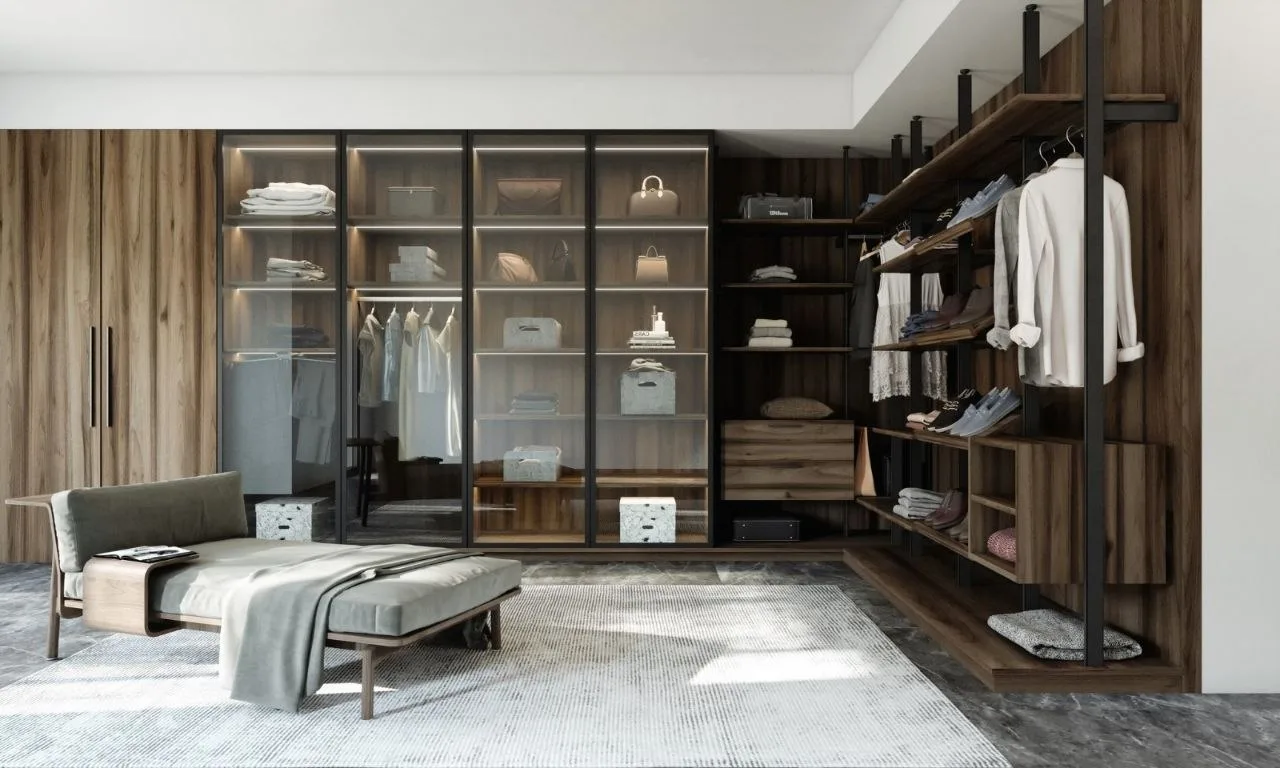
A well-designed custom wardrobe integrates lighting, accessories and finishes within a single, cohesive visual language.
Storage accessories: an investment that is often underestimated
The structure of the wardrobe (carcasses, shelves, hanging rails) represents only part of its actual utility. It is the accessories that transform a storage unit into a tool perfectly suited to daily life: integrated laundry baskets, velvet-lined drawers for accessories, double hanging rails for shorter garments, angled shoe shelves. These elements carry a unit cost that accumulates quickly, but they determine the experience of use for years to come. At Osmosis Home, every project includes a functional design phase in which spaces are allocated according to the client's real habits, before the aesthetic finish is confirmed. The result is a wardrobe that is used naturally, without having to adapt one's movements to the furniture, rather, the furniture adapts to the movements. To explore this design philosophy further, our article on how to fit out a custom wardrobe combining elegance and practicality goes deeper into interior organisation choices.
Moroccan expatriates and investors: what bespoke quality does for property value
A point frequently raised by Moroccans living abroad who are preparing a residence in Tangier or another city in the country: a quality custom wardrobe is not an expense : it is an enhancement. A property fitted with a well-designed wardrobe, in durable materials with a refined finish, stands out immediately during a viewing, whether for a high-end rental or a resale. The cost of bespoke work depreciates differently from flat-pack furniture: it does not lose its value in the same way, and it does not need replacing after five years. It is this argument of durability and residual value that often steers projects towards a higher specification once the client has had the opportunity to compare. Our recent installations bear testament to this, across projects ranging from studio apartments to private villas.
How to obtain an accurate price for your wardrobe
There is no universal pricing grid because every space is different. The only way to obtain a reliable budget is to submit your project to a professional capable of taking measurements, assessing technical constraints, and proposing a tailored design. At Osmosis Home, the process begins with an initial point of contact (in the showroom on Avenue Abderrahman El Youssoufi in Tangier, or remotely for clients based in Europe) followed by a technical site visit and a detailed, no-obligation quotation. It is only at this stage that an accurate price can be provided, and an informed decision made.
Conclusion
The price of a custom wardrobe in Morocco depends on parameters too specific to be reduced to a single figure: the surface area, the configuration, the materials, the accessories, and the quality of execution combine in a unique way for every project. What is certain is that the gap between an entry-level solution and a thoughtfully designed custom wardrobe is measured not by the initial expenditure, but by daily use over ten, fifteen or twenty years. If you are considering such a project for your home, we would be delighted to discuss it with you. Describe your project and our team will get back to you to explore the possibilities together.